
Theranostics in Europe — Market Research
Europe is the world’s largest theranostics practice by patient volume but a mid-sized market by revenue: branded radioligand therapy sales in Europe are likely USD 0.4–0.7 billion a year, delivered mostly by public university hospitals, with demand limited by isotope supply and specialist staff.
- Turnover. Novartis’s Pluvicto and Lutathera sold USD 2.81 bn worldwide in 2025; Europe is not disclosed. Analyst estimates of the European radiopharmaceutical theranostics market range from USD 0.3 to 0.9 bn; broader definitions reach USD 32 bn.
- Centres. About 86 European centres hold EARL Theranostics Centre of Excellence certification (France leads with 19 of 112 worldwide); Germany alone had 44 departments delivering Lu-PSMA by 2020.
- Public vs private. Delivery is public and academic in the EU (70% university hospitals in Germany; regionally authorised SSN centres in Italy). Private self-pay channels exist mainly in the UK, Ireland, Austria and Spain, driven by NICE’s refusal to fund Pluvicto.
- Patient results. Phase III trials show progression delayed by 2–3 times (VISION OS 15.3 vs 11.3 months; PSMAfore rPFS 12.0 vs 5.6; NETTER-2 PFS 22.8 vs 8.5), with overall-survival benefit still unproven outside VISION.
Products on the European market
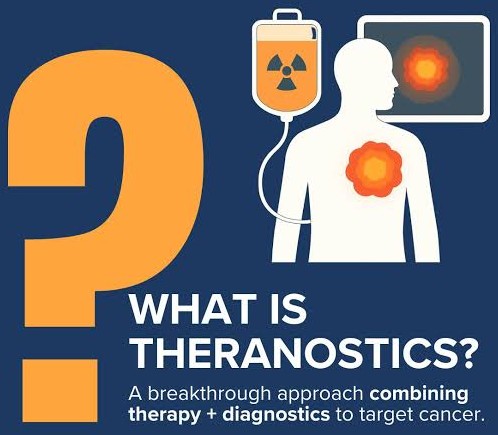
European theranostics revenue is still dominated by two Novartis lutetium-177 radioligand therapies (RLT); everything else is older radionuclide therapy, in-house or galenic preparations, or pipeline. Both products pair a diagnostic PET scan with a therapy aimed at the same target.
| Product | Target / indication | EU status | Notes |
|---|---|---|---|
| Pluvicto (177Lu-PSMA-617, Novartis) | PSMA+ metastatic prostate cancer | Approved post-ARPI and post-taxane; earlier lines approved in the US and China in Q3 2026 | Reimbursed by the Italian SSN since 4 March 2025, with an AIFA registry and managed-entry agreement (AIFA) |
| Lutathera (177Lu-DOTATATE, Novartis) | SSTR+ gastroenteropancreatic neuroendocrine tumours (GEP-NETs) | Approved for progressive, well-differentiated G1–G2 GEP-NETs | Generic challengers (Lantheus, Curium) cleared in the US; patent appeal ongoing |
| 177Lu-PSMA-I&T (Curium, GMP, unlicensed) | PSMA+ prostate cancer | Galenic / non-licensed preparation used across Europe (Mater Private) | Main low-cost alternative to Pluvicto; also produced in-house by hospital radiopharmacies |
| ITM-11 (177Lu-edotreotide, ITM, Germany) | SSTR+ GEP-NETs | Not approved; FDA issued a CRL in August 2026 over manufacturing issues (OncLive) | European challenger to Lutathera; COMPETE PFS 23.9 vs 14.1 months vs everolimus |
Open question: whether the EMA has extended Pluvicto to the pre-taxane or hormone-sensitive settings in Europe — sources found confirm only the post-taxane EU label.
Market size and turnover
The hard number is Novartis: Pluvicto and Lutathera sold USD 2.81 billion worldwide in 2025 (USD 1,994 m and 816 m), and Pluvicto alone reached USD 1,967 m in the first nine months of 2026 (Novartis FY2025, Novartis Q3 2026). Novartis does not split Europe out; growth is US-led, with Europe cited mainly for post-taxane access expansion and Lutathera demand.
A European figure therefore has to be estimated. Assuming Europe is 15–25% of Novartis RLT sales (an assumption, not a reported figure), EU branded RLT turnover is roughly USD 0.4–0.7 billion a year, before in-house PSMA-I&T, radium-223, iodine-131 and the diagnostic PET tracers that go with every therapy.
Published analyst estimates disagree by two orders of magnitude because they define the market differently:
| Report | Scope | Size | Forecast |
|---|---|---|---|
| MarketsandMarkets | Europe theranostics | USD 288 m (2023) | USD 698 m by 2028, 19.4% CAGR |
| Business Market Insights | Europe radiopharmaceutical theranostics | USD 462 m (2022) | USD 854 m by 2028; Germany largest |
| MarketsandMarkets | Europe nuclear medicine (diagnostic + therapy) | USD 2.47 bn (2025) | USD 5.15 bn by 2030, 15.8% CAGR |
| Market Data Forecast | Europe theranostics incl. imaging, IVD, software | USD 32.1 bn (2025) | USD 84.5 bn by 2034 |
The first two (radiopharmaceutical-only) are the closest to real drug turnover and are consistent with the Novartis-based estimate once growth since 2023 is added.
Active centres
There is no official EU registry of theranostic centres; the best proxies point to roughly 90–100 quality-certified European centres within a wider base of several hundred nuclear medicine departments delivering RLT.
- EARL (EANM) Theranostics Centres of Excellence. In the first year of the programme (to 30 June 2025), 112 centres in 33 countries were certified; 77% were in Europe (about 86) and France had the most, 19 centres (Hristova et al., EANM Innovation 2026). A Level 2 “Advanced” tier now requires two or more radiopharmaceuticals and a target of 250 therapies a year; Institut Jules Bordet / H.U.B. in Brussels is one Level 2 site (Bordet).
- Centre size varies 150-fold. Certified centres administered 11 to 1,718 therapies a year; 64% (72 of 112) reported 250 or more.
- ICPO network. A separate private accreditation (ICPO Foundation) counted 45 Theranostics Clinical Centres of Excellence after adding 24 at EANM 2025 in Barcelona, with a target of 100 by 2026 (ICPO).
- Europe leads on volume. In an international survey of 95 Lu-PSMA centres (2022), 51% were European and they treated 2,840 of 5,906 patients (48%) in the prior 12 months (Farolfi et al., JNM 2024).
- Germany is the largest single market: departments billing Lu-PSMA rose from 25 in 2016 to 44 in 2020, and annual cycles from about 1,000 to over 3,300 (EJNMMI 2023).
- Italy has no national count: under the AIFA determination, each Region designates the authorised Pluvicto and Lutathera centres. Puglia, for example, lists six Pluvicto centres (Regione Puglia) and Sardinia two (Regione Sardegna).
Capacity is limited by people more than buildings: certified centres reported a median of one nuclear medicine physician per 50 therapies and one medical physicist per 138.
Public vs private delivery
In continental Europe theranostics is overwhelmingly a public, hospital-based activity, led by university hospitals; private providers matter mainly where public reimbursement is missing (UK) or as a self-pay channel for patients travelling abroad. No source gives a pan-European public/private split.
| Country | Who delivers | Funding situation |
|---|---|---|
| Germany | University hospitals did 88% of Lu-PSMA in 2016 and 70% in 2020; the rest is non-university hospitals (EJNMMI 2023) | Inpatient procedure code reimbursed for all patients, regardless of insurance status |
| Italy | Public SSN nuclear medicine units designated by each Region (e.g. Istituto Nazionale dei Tumori, Milan, treated 80 Pluvicto patients in just over a year) | Pluvicto reimbursed since March 2025 with AIFA registry and managed-entry agreement; Lutathera already reimbursed |
| UK (England, Wales) | NHS access to Pluvicto blocked; private hospitals offer self-funded treatment | NICE rejected Pluvicto post-taxane on cost-effectiveness (TA930) and terminated the pre-taxane appraisal in July 2026 after no company submission (TA1179) |
| Ireland, Austria, Spain | Private hospitals and clinics market Lu-PSMA directly, e.g. Mater Private Dublin (Mater Private), private practices in Vienna for self-paying patients | Self-pay prices of about USD 27,000 per cycle are quoted by medical-tourism platforms for Spain (indicative only) |
For a supplier, the practical consequence is that the buying decision sits with public hospital nuclear medicine and radiopharmacy departments, under regional or national tenders, in almost every EU market.
Results on patients
Every pivotal Phase III trial has met its progression endpoint, roughly doubling or tripling time without progression; only VISION has so far shown a statistically significant overall-survival gain, which is why payers like NICE remain cautious.
| Trial | Setting | Progression-free survival | Overall survival / other |
|---|---|---|---|
| VISION (Pluvicto, n=831) | Prostate cancer after ARPI and taxane | rPFS 8.7 vs 3.4 months | OS 15.3 vs 11.3 months (HR 0.62); grade 3–5 adverse events 28.4% vs 3.9% |
| PSMAfore (Pluvicto) | Prostate cancer after ARPI, before chemo | rPFS 12.0 vs 5.6 months (HR 0.41) | OS confounded by 84% crossover (adjusted HR 0.80, not significant); PSA ≥50% decline 57.6% vs 20.4% |
| PSMAddition (Pluvicto) | Hormone-sensitive prostate cancer | 28% lower risk of progression or death vs standard care | OS trend positive at interim, not yet significant |
| NETTER-2 (Lutathera) | First-line G2/G3 GEP-NETs | 22.8 vs 8.5 months (HR 0.28) | Response rate 43% vs 9.3% |
| COMPETE (ITM-11, n=309) | G1/G2 GEP-NETs vs everolimus | 23.9 vs 14.1 months | OS 63.4 vs 58.7 months, not significant |
Real-world European data are consistent with the trials: in a German 12-centre series of 145 patients, 45% had a PSA decline of 50% or more and grade 3–4 blood toxicity stayed in single digits (JNM 2017). Waiting times matter too: European centres started Lu-PSMA therapy almost three times faster than Brazilian ones in a 2026 comparison (JNM 2026).
Supply chain and key players
Isotope supply, not demand, is the binding constraint: Europe hosts most of the Lu-177 value chain but depends on a handful of ageing research reactors.
- Reactors. A pipe deformation took the High Flux Reactor in Petten (NL) offline in late 2024 while Polish and Belgian reactors were in maintenance, cancelling thousands of patient appointments (Science & Medicine Group). PALLAS is being built at Petten as its replacement (NEI Magazine).
- Italy’s role. Novartis’s original Pluvicto plant is in Ivrea (Piedmont); demand outran that single site after launch, leading to a 2023 shortage.
- Isotope and drug suppliers. Curium (France/NL, Lu-177 lines at Petten since 2024, plus PSMA-I&T), ITM (Munich; supplies over 600 clinics in 60+ countries, NOVA plant in Garching) (European Biotechnology), Eckert & Ziegler, NRG I PALLAS and SCK CEN (Belgium).
- Logistics. Doses must reach European clinics within 24–48 hours, and orders often arrive only days before treatment.
The Lu-177 isotope market alone was sized at USD 1.4 billion globally in 2025 (TBRC via GII).
Outlook and implications
Demand will keep outrunning capacity for the next 2–3 years, so the winners will be whoever removes bottlenecks in centres, staff and isotopes.
- Patient pool expands. Pluvicto moving into pre-taxane and hormone-sensitive disease adds about 75% more eligible patients, according to Novartis management (Q4 2025 call); NETTER-2 moves Lutathera to first line in G2/G3 NETs. EU label and reimbursement follow 12–24 months behind the US.
- Competition arrives. ITM-11 (after its CRL is resolved), Lutathera generics and a pipeline from AstraZeneca, Lilly, Bayer and Curium will push prices down and broaden indications.
- Payer friction stays. NICE’s two negative or terminated appraisals show that OS evidence and cost-effectiveness, not efficacy on progression, decide access.
- Centre accreditation spreads. EARL Level 2 (250+ therapies a year, multiple agents) is becoming the quality benchmark that hospitals, regulators and industry partners use to pick reference sites.
For AI software in nuclear medicine (dosimetry, PSMA PET quantification, response assessment, workflow), the opening is the staffing gap — one physician per 50 therapies and one physicist per 138 in certified centres — and the protocol heterogeneity the international surveys keep finding. EARL-certified and high-volume university centres are the natural first accounts, and in Italy the selling unit is the regionally authorised SSN nuclear medicine department.
Sources
- Novartis FY 2025 results release, 4 Feb 2026
- Novartis Q3 2026 results release, 27 Oct 2026
- Novartis Q4 2025 earnings call transcript
- Precision Medicine Online — Lutathera generics and Q2 2026
- Hristova et al., EARL Theranostics CoE certification, EANM Innovation 2026
- ICPO Foundation — 24 new Centers of Excellence, Oct 2025
- Farolfi et al., survey of 95 theranostic centres, JNM 2024
- Lu-PSMA adoption in Germany 2016–2020, EJNMMI 2023
- AIFA — Pluvicto registry activation
- Regione Puglia — authorised Pluvicto centres
- Regione Sardegna — authorised Pluvicto centres
- NICE TA930 and NICE TA1179
- VISION results, ASCO 2021 (UroToday)
- PSMAfore results (Novartis)
- NETTER-2 results (Novartis)
- COMPETE / ITM-11 (Pharmaceutical Technology) and FDA CRL (OncLive)
- Radiopharmaceutical supply chain under pressure, May 2026
- ITM production capacity (European Biotechnology)
- MarketsandMarkets Europe theranostics, Business Market Insights, Market Data Forecast
- Mater Private Dublin — theranostics
